Little Dorrit (December 1855 to June 1857)
Chapters 1 – 5
Characters to be Introduced in these Chapters:
“Signor” John Baptist Cavalleto
“Monsieur” Rigaud
Mr. Meagles
Mrs. Meagles
Miss Meagles, or “Pet”
Tattycoram, or Harriet Beadle
Miss Wade
Mr. Arthur Clennam
Mrs. Clennam
Jeremiah Flintwinch
Affery Flintwinch
“Little” Dorrit
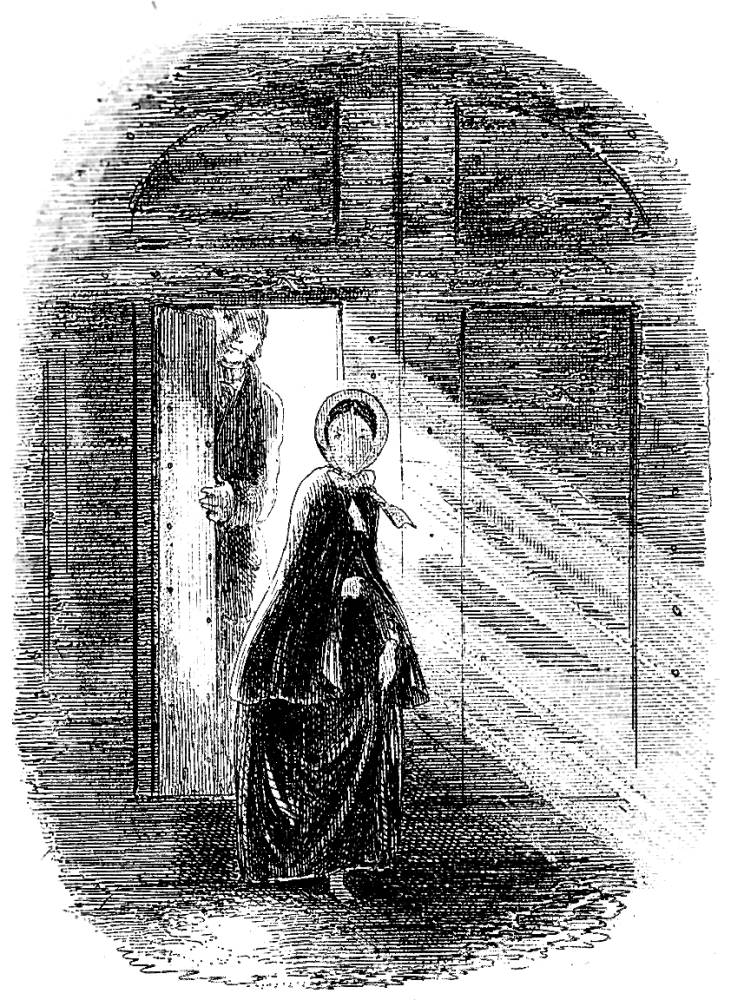
➤ Chapter 1 – Sun and Shadow
The blazing sun of Marseilles is described in order to form a contrast with the darkness and filth of a “villainous” prison where “Signor” John Baptist Cavalleto and “Monsieur” Rigaud are sharing a cell. John Baptist is bullied by Rigaud, who also takes most of the food and enjoys alone any privileges that are granted. Rigaud refers to himself as a gentleman and tells the story of how he married a widow who had just inherited her dead husband’s estate, but who – after an argument with Rigaud – threw herself from a height above the sea and died on the rocks below. Rigaud is soon marched from the cell, to his execution we are led to believe.
➤ Chapter 2 – Fellow-Travellers
The chapter opens with unknown voices speaking ill of Marseilles and the French people as they remain in quarantine because they have just “come from the East, and […] the East is the country of the plague.” We learn that one of the voices belongs to a Mr. Meagles. His wife, Mrs. Meagles, is also present, as well as their daughter who goes by “Pet.” It is immediately apparent that Pet is quite spoiled, although we don’t see much indication that this has affected her character. She is waited upon by a young lady called “Tattycoram,” an orphan whose real name is Harriet Beadle and was adopted by the Meagles for the purpose of being Pet’s maid and perhaps also to make up for the fact that Pet had a twin sister who died as a small child. It is finally revealed that the other interlocutor in this conversation with the Meagles is a Mr. Clennam, who briefly describes his strict family upbringing. After leaving quarantine and landing all at the same hotel, they meet a Miss Wade at dinner. A back-and-forth conversation ensues in which Miss Wade seems to question the possibility of forgiving someone, or some place, that has been a source of pain: “If I had been shut up in any place to pine and suffer, I should always hate that place, and wish to burn it down, or raze it to the ground.” Miss Wade cuts a distant and aloof figure after dinner and parts with more enigmatic words: “In our course through life we shall meet the people who are coming to meet us, from many strange places and by many strange roads … and what it is set to us to do to them, as what it is set to them to do to us, will all be done.” Leaving the assembled dinner guests and walking to her room, Miss Wade stumbles upon Tattycoram in tears and raging against the Meagles and their coddling of Pet at Tattycoram’s expense. She also tells Miss Wade to go away because she is afraid of her and suggests that Miss Wade enjoys seeing her in distress. For her part, Miss Wade tells Tattycoram that she must have patience and be more prudent in her dependent condition. At the chapter’s end, Tattycoram backtracks upon her words against the Meagles and blames her earlier behavior on her temper, but reiterates her fear of Miss Wade.
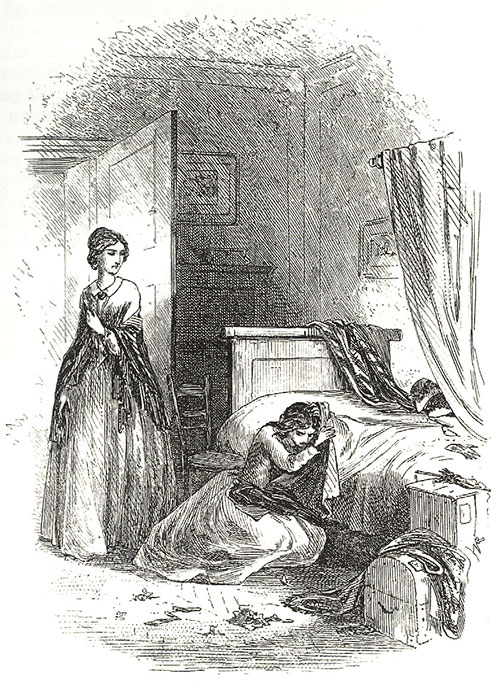
➤ Chapter 3 – Home
The chapter title is a reference to Mr. Arthur Clennam’s home in London, as he returns after the death of his father and his self-imposed “exile.” He is shown rather formally, albeit with familiarity by the butler, to his mother’s room. Mrs. Clennam is reminiscent of a future Dickens character, Miss Havisham (from Great Expectations), in that she hasn’t left her bedroom for a dozen years. It is here where we first meet Affery Flintwinch, one of the servants whom Arthur seems to remember fondly. There follows a discussion of a watch that was sent to his mother upon his father’s death, which Arthur was present at. After his mother retires to bed, we meet Jeremiah Flintwinch, long-time servant to the house and Affery’s husband. We learn that the Flintwinch’s marriage was a curious affair, Affery being told (by Jeremiah) that it was best for household affairs that the two servants be married. It is at the end of this chapter that we meet Little Dorrit, who was spied by Arthur Clennam as she waited upon the previous scenes “in a dark corner.”
➤ Chapter 4 – Mrs. Flintwinch has a Dream
Affery Flintwinch has a dream involving doubles of herself and Jeremiah Flintwinch. The dream is perhaps unremarkable except for an overwhelming fear she has of her husband in the dream.
➤ Chapter 5 – Family Affairs
The next morning, Arthur Clennam and his mother meet rather formally to discuss the estate and will of his late father. Arthur reiterates his decision to abandon the family business and recognizes that Mrs. Clennam has always been the engine behind the business anyway. Arthur has just one question for his mother, which upsets her terribly: whether his father had any secret remembrance that caused him “trouble of mind” or remorse: “Is it possible, mother, that he had unhappily wronged anyone and made no reparation?” At this question, Mrs. Clennam flies into despair and rage and sends for Jeremiah Flintwinch, who begins to mediate between mother and son. Mrs. Clennam announces that, since Arthur wants no part of the family business, she and Jeremiah will assume the responsibility and control of it, which seems to please Jeremiah as his “eyes glistened as if they saw money.” The meeting is halted abruptly as oysters are brought in for Mrs. Clennam and they are delivered by Little Dorrit who, despite the suggestion that she is twenty-two years old, appears “diminutive” and might be taken for half that age, having “all the manner and much of the appearance of a subdued child.” We learn that Mrs. Clennam shows a special interest in Little Dorrit, much in contrast to her demeanor and opinion of “all the rest of humanity.” We learn that meals are part of Little Dorrit’s remuneration and that she appears punctually at 8 in the morning and leaves again at 8 in the evening and “what became of Little Dorrit between the two eights was a mystery.” The rest of the day and chapter are spent by Arthur wandering through the old house, which is notable for its age and decay, to the point where Arthur decides to take up lodging at the coffee-house. However, intrigued by Little Dorrit’s presence and his mother’s interest in her, he decides to learn all he can about her.
Chapters 1 – 5: Thoughts & Analysis
Each of these early chapters introduces a set, or tiny world, of characters whose orbits will certainly align as the story progresses. Past and future Dickensian themes are present, such as wills, matters of estate, houses (in ruins) as metaphors for the family (in ruins, also?), and especially the figure of Mrs. Clennam who resembles Great Expectations’ Miss Havisham in her state and demeanor, and even her “relationship” with Little Dorrit, which foreshadows Miss Havisham’s relationship with Estella. Great Expectations would come just five years after Little Dorrit. Miss Wade is the other great “pending issue” of this section, as we’re sure to learn more of the story behind her strong opinions on forgiveness and place.
 brentalanjames